Appendix F - Personal observations on the reliability of the Shuttle
by R. P. Feynman
Introduction
It appears that there are enormous differences of opinion as to the
probability of a failure with loss of vehicle and of human life. The
estimates range from roughly 1 in 100 to 1 in 100,000. The higher
figures come from the working engineers, and the very low figures from
management. What are the causes and consequences of this lack of
agreement? Since 1 part in 100,000 would imply that one could put a
Shuttle up each day for 300 years expecting to lose only one, we could
properly ask "What is the cause of management's fantastic faith in the
machinery?"
We have also found that certification criteria used in Flight
Readiness Reviews often develop a gradually decreasing strictness. The
argument that the same risk was flown before without failure is often
accepted as an argument for the safety of accepting it again. Because
of this, obvious weaknesses are accepted again and again, sometimes
without a sufficiently serious attempt to remedy them, or to delay a
flight because of their continued presence.
There are several sources of information. There are published criteria
for certification, including a history of modifications in the form of
waivers and deviations. In addition, the records of the Flight
Readiness Reviews for each flight document the arguments used to
accept the risks of the flight. Information was obtained from the
direct testimony and the reports of the range safety officer, Louis
J. Ullian, with respect to the history of success of solid fuel
rockets. There was a further study by him (as chairman of the launch
abort safety panel (LASP)) in an attempt to determine the risks
involved in possible accidents leading to radioactive contamination
from attempting to fly a plutonium power supply (RTG) for future
planetary missions. The NASA study of the same question is also
available. For the History of the Space Shuttle Main Engines,
interviews with management and engineers at Marshall, and informal
interviews with engineers at Rocketdyne, were made. An independent
(Cal Tech) mechanical engineer who consulted for NASA about engines
was also interviewed informally. A visit to Johnson was made to gather
information on the reliability of the avionics (computers, sensors,
and effectors). Finally there is a report "A Review of Certification
Practices, Potentially Applicable to Man-rated Reusable Rocket
Engines," prepared at the Jet Propulsion Laboratory by N. Moore, et
al., in February, 1986, for NASA Headquarters, Office of Space
Flight. It deals with the methods used by the FAA and the military to
certify their gas turbine and rocket engines. These authors were also
interviewed informally.
Solid Rockets (SRB)
An estimate of the reliability of solid rockets was made by the range
safety officer, by studying the experience of all previous rocket
flights. Out of a total of nearly 2,900 flights, 121 failed (1 in
25). This includes, however, what may be called, early errors, rockets
flown for the first few times in which design errors are discovered
and fixed. A more reasonable figure for the mature rockets might be 1
in 50. With special care in the selection of parts and in inspection,
a figure of below 1 in 100 might be achieved but 1 in 1,000 is
probably not attainable with today's technology. (Since there are two
rockets on the Shuttle, these rocket failure rates must be doubled to
get Shuttle failure rates from Solid Rocket Booster failure.)
NASA officials argue that the figure is much lower. They point out
that these figures are for unmanned rockets but since the Shuttle is a
manned vehicle "the probability of mission success is necessarily very
close to 1.0." It is not very clear what this phrase means. Does it
mean it is close to 1 or that it ought to be close to 1? They go on to
explain "Historically this extremely high degree of mission success
has given rise to a difference in philosophy between manned space
flight programs and unmanned programs; i.e., numerical probability
usage versus engineering judgment." (These quotations are from "Space
Shuttle Data for Planetary Mission RTG Safety Analysis," Pages 3-1,
3-1, February 15, 1985, NASA, JSC.) It is true that if the probability
of failure was as low as 1 in 100,000 it would take an inordinate
number of tests to determine it ( you would get nothing but a string
of perfect flights from which no precise figure, other than that the
probability is likely less than the number of such flights in the
string so far). But, if the real probability is not so small, flights
would show troubles, near failures, and possible actual failures with
a reasonable number of trials. and standard statistical methods could
give a reasonable estimate. In fact, previous NASA experience had
shown, on occasion, just such difficulties, near accidents, and
accidents, all giving warning that the probability of flight failure
was not so very small. The inconsistency of the argument not to
determine reliability through historical experience, as the range
safety officer did, is that NASA also appeals to history, beginning
"Historically this high degree of mission success..."
Finally, if we are to replace standard numerical probability usage
with engineering judgment, why do we find such an enormous disparity
between the management estimate and the judgment of the engineers? It
would appear that, for whatever purpose, be it for internal or
external consumption, the management of NASA exaggerates the
reliability of its product, to the point of fantasy.
The history of the certification and Flight Readiness Reviews will not
be repeated here. (See other part of Commission reports.) The
phenomenon of accepting for flight, seals that had shown erosion and
blow-by in previous flights, is very clear. The Challenger flight is
an excellent example. There are several references to flights that had
gone before. The acceptance and success of these flights is taken as
evidence of safety. But erosion and blow-by are not what the design
expected. They are warnings that something is wrong. The equipment is
not operating as expected, and therefore there is a danger that it can
operate with even wider deviations in this unexpected and not
thoroughly understood way. The fact that this danger did not lead to a
catastrophe before is no guarantee that it will not the next time,
unless it is completely understood. When playing Russian roulette the
fact that the first shot got off safely is little comfort for the
next. The origin and consequences of the erosion and blow-by were not
understood. They did not occur equally on all flights and all joints;
sometimes more, and sometimes less. Why not sometime, when whatever
conditions determined it were right, still more leading to
catastrophe?
In spite of these variations from case to case, officials behaved as
if they understood it, giving apparently logical arguments to each
other often depending on the "success" of previous flights. For
example. in determining if flight 51-L was safe to fly in the face of
ring erosion in flight 51-C, it was noted that the erosion depth was
only one-third of the radius. It had been noted in an experiment
cutting the ring that cutting it as deep as one radius was necessary
before the ring failed. Instead of being very concerned that
variations of poorly understood conditions might reasonably create a
deeper erosion this time, it was asserted, there was "a safety factor
of three." This is a strange use of the engineer's term ,"safety
factor." If a bridge is built to withstand a certain load without the
beams permanently deforming, cracking, or breaking, it may be designed
for the materials used to actually stand up under three times the
load. This "safety factor" is to allow for uncertain excesses of load,
or unknown extra loads, or weaknesses in the material that might have
unexpected flaws, etc. If now the expected load comes on to the new
bridge and a crack appears in a beam, this is a failure of the
design. There was no safety factor at all; even though the bridge did
not actually collapse because the crack went only one-third of the way
through the beam. The O-rings of the Solid Rocket Boosters were not
designed to erode. Erosion was a clue that something was wrong.
Erosion was not something from which safety can be inferred.
There was no way, without full understanding, that one could have
confidence that conditions the next time might not produce erosion
three times more severe than the time before. Nevertheless, officials
fooled themselves into thinking they had such understanding and
confidence, in spite of the peculiar variations from case to case. A
mathematical model was made to calculate erosion. This was a model
based not on physical understanding but on empirical curve fitting. To
be more detailed, it was supposed a stream of hot gas impinged on the
O-ring material, and the heat was determined at the point of
stagnation (so far, with reasonable physical, thermodynamic laws). But
to determine how much rubber eroded it was assumed this depended only
on this heat by a formula suggested by data on a similar material. A
logarithmic plot suggested a straight line, so it was supposed that
the erosion varied as the .58 power of the heat, the .58 being
determined by a nearest fit. At any rate, adjusting some other
numbers, it was determined that the model agreed with the erosion (to
depth of one-third the radius of the ring). There is nothing much so
wrong with this as believing the answer! Uncertainties appear
everywhere. How strong the gas stream might be was unpredictable, it
depended on holes formed in the putty. Blow-by showed that the ring
might fail even though not, or only partially eroded through. The
empirical formula was known to be uncertain, for it did not go
directly through the very data points by which it was
determined. There were a cloud of points some twice above, and some
twice below the fitted curve, so erosions twice predicted were
reasonable from that cause alone. Similar uncertainties surrounded the
other constants in the formula, etc., etc. When using a mathematical
model careful attention must be given to uncertainties in the model.
Liquid Fuel Engine (SSME)
During the flight of 51-L the three Space Shuttle Main Engines all
worked perfectly, even, at the last moment, beginning to shut down the
engines as the fuel supply began to fail. The question arises,
however, as to whether, had it failed, and we were to investigate it
in as much detail as we did the Solid Rocket Booster, we would find a
similar lack of attention to faults and a deteriorating
reliability. In other words, were the organization weaknesses that
contributed to the accident confined to the Solid Rocket Booster
sector or were they a more general characteristic of NASA? To that end
the Space Shuttle Main Engines and the avionics were both
investigated. No similar study of the Orbiter, or the External Tank
were made.
The engine is a much more complicated structure than the Solid
Rocket Booster, and a great deal more detailed engineering goes into
it. Generally, the engineering seems to be of high quality and
apparently considerable attention is paid to deficiencies and faults
found in operation.
The usual way that such engines are designed (for military or
civilian aircraft) may be called the component system, or bottom-up
design. First it is necessary to thoroughly understand the properties
and limitations of the materials to be used (for turbine blades, for
example), and tests are begun in experimental rigs to determine
those. With this knowledge larger component parts (such as bearings)
are designed and tested individually. As deficiencies and design
errors are noted they are corrected and verified with further
testing. Since one tests only parts at a time these tests and
modifications are not overly expensive. Finally one works up to the
final design of the entire engine, to the necessary
specifications. There is a good chance, by this time that the engine
will generally succeed, or that any failures are easily isolated and
analyzed because the failure modes, limitations of materials, etc.,
are so well understood. There is a very good chance that the
modifications to the engine to get around the final difficulties are
not very hard to make, for most of the serious problems have already
been discovered and dealt with in the earlier, less expensive, stages
of the process.
The Space Shuttle Main Engine was handled in a different manner,
top down, we might say. The engine was designed and put together all
at once with relatively little detailed preliminary study of the
material and components. Then when troubles are found in the
bearings, turbine blades, coolant pipes, etc., it is more expensive
and difficult to discover the causes and make changes. For example,
cracks have been found in the turbine blades of the high pressure
oxygen turbopump. Are they caused by flaws in the material, the effect
of the oxygen atmosphere on the properties of the material, the
thermal stresses of startup or shutdown, the vibration and stresses of
steady running, or mainly at some resonance at certain speeds, etc.?
How long can we run from crack initiation to crack failure, and how
does this depend on power level? Using the completed engine as a test
bed to resolve such questions is extremely expensive. One does not
wish to lose an entire engine in order to find out where and how
failure occurs. Yet, an accurate knowledge of this information is
essential to acquire a confidence in the engine reliability in use.
Without detailed understanding, confidence can not be attained.
A further disadvantage of the top-down method is that, if an
understanding of a fault is obtained, a simple fix, such as a new
shape for the turbine housing, may be impossible to implement without
a redesign of the entire engine.
The Space Shuttle Main Engine is a very remarkable machine. It has
a greater ratio of thrust to weight than any previous engine. It is
built at the edge of, or outside of, previous engineering
experience. Therefore, as expected, many different kinds of flaws and
difficulties have turned up. Because, unfortunately, it was built in
the top-down manner, they are difficult to find and fix. The design
aim of a lifetime of 55 missions equivalent firings (27,000 seconds of
operation, either in a mission of 500 seconds, or on a test stand) has
not been obtained. The engine now requires very frequent maintenance
and replacement of important parts, such as turbopumps, bearings,
sheet metal housings, etc. The high-pressure fuel turbopump had to be
replaced every three or four mission equivalents (although that may
have been fixed, now) and the high pressure oxygen turbopump every
five or six. This is at most ten percent of the original
specification. But our main concern here is the determination of
reliability.
In a total of about 250,000 seconds of operation, the engines have
failed seriously perhaps 16 times. Engineering pays close attention to
these failings and tries to remedy them as quickly as possible. This
it does by test studies on special rigs experimentally designed for
the flaws in question, by careful inspection of the engine for
suggestive clues (like cracks), and by considerable study and
analysis. In this way, in spite of the difficulties of top-down
design, through hard work, many of the problems have apparently been
solved.
A list of some of the problems follows. Those followed by an
asterisk (*) are probably solved:
1.Turbine blade cracks in high pressure fuel turbopumps (HPFTP). (May have been solved.)
2.Turbine blade cracks in high pressure oxygen turbopumps (HPOTP).
3.Augmented Spark Igniter (ASI) line rupture.*
4.Purge check valve failure.*
5.ASI chamber erosion.*
6.HPFTP turbine sheet metal cracking.
7.HPFTP coolant liner failure.*
8.Main combustion chamber outlet elbow failure.*
9.Main combustion chamber inlet elbow weld offset.*
10.HPOTP subsynchronous whirl.*
11.Flight acceleration safety cutoff system (partial failure in a redundant system).*
12.Bearing spalling (partially solved).
13.A vibration at 4,000 Hertz making some engines inoperable, etc.
Many of these solved problems are the early difficulties of a new
design, for 13 of them occurred in the first 125,000 seconds and only
three in the second 125,000 seconds. Naturally, one can never be sure
that all the bugs are out, and, for some, the fix may not have
addressed the true cause. Thus, it is not unreasonable to guess there
may be at least one surprise in the next 250,000 seconds, a
probability of 1/500 per engine per mission. On a mission there are
three engines, but some accidents would possibly be contained, and
only affect one engine. The system can abort with only two
engines. Therefore let us say that the unknown suprises do not, even
of themselves, permit us to guess that the probability of mission
failure do to the Space Shuttle Main Engine is less than 1/500. To
this we must add the chance of failure from known, but as yet
unsolved, problems (those without the asterisk in the list
above). These we discuss below. (Engineers at Rocketdyne, the
manufacturer, estimate the total probability as 1/10,000. Engineers at
marshal estimate it as 1/300, while NASA management, to whom these
engineers report, claims it is 1/100,000. An independent engineer
consulting for NASA thought 1 or 2 per 100 a reasonable estimate.)
The history of the certification principles for these engines is
confusing and difficult to explain. Initially the rule seems to have
been that two sample engines must each have had twice the time
operating without failure as the operating time of the engine to be
certified (rule of 2x). At least that is the FAA practice, and NASA
seems to have adopted it, originally expecting the certified time to
be 10 missions (hence 20 missions for each sample). Obviously the best
engines to use for comparison would be those of greatest total (flight
plus test) operating time -- the so-called "fleet leaders." But what
if a third sample and several others fail in a short time? Surely we
will not be safe because two were unusual in lasting longer. The short
time might be more representative of the real possibilities, and in
the spirit of the safety factor of 2, we should only operate at half
the time of the short-lived samples.
The slow shift toward decreasing safety factor can be seen in many
examples. We take that of the HPFTP turbine blades. First of all the
idea of testing an entire engine was abandoned. Each engine number has
had many important parts (like the turbopumps themselves) replaced at
frequent intervals, so that the rule must be shifted from engines to
components. We accept an HPFTP for a certification time if two samples
have each run successfully for twice that time (and of course, as a
practical matter, no longer insisting that this time be as large as 10
missions). But what is "successfully?" The FAA calls a turbine blade
crack a failure, in order, in practice, to really provide a safety
factor greater than 2. There is some time that an engine can run
between the time a crack originally starts until the time it has grown
large enough to fracture. (The FAA is contemplating new rules that
take this extra safety time into account, but only if it is very
carefully analyzed through known models within a known range of
experience and with materials thoroughly tested. None of these
conditions apply to the Space Shuttle Main Engine.
Cracks were found in many second stage HPFTP turbine blades. In one
case three were found after 1,900 seconds, while in another they were
not found after 4,200 seconds, although usually these longer runs
showed cracks. To follow this story further we shall have to realize
that the stress depends a great deal on the power level. The
Challenger flight was to be at, and previous flights had been at, a
power level called 104% of rated power level during most of the time
the engines were operating. Judging from some material data it is
supposed that at the level 104% of rated power level, the time to
crack is about twice that at 109% or full power level (FPL). Future
flights were to be at this level because of heavier payloads, and many
tests were made at this level. Therefore dividing time at 104% by 2,
we obtain units called equivalent full power level (EFPL). (Obviously,
some uncertainty is introduced by that, but it has not been studied.)
The earliest cracks mentioned above occurred at 1,375 EFPL.
Now the certification rule becomes "limit all second stage blades
to a maximum of 1,375 seconds EFPL." If one objects that the safety
factor of 2 is lost it is pointed out that the one turbine ran for
3,800 seconds EFPL without cracks, and half of this is 1,900 so we are
being more conservative. We have fooled ourselves in three ways. First
we have only one sample, and it is not the fleet leader, for the other
two samples of 3,800 or more seconds had 17 cracked blades between
them. (There are 59 blades in the engine.) Next we have abandoned the
2x rule and substituted equal time. And finally, 1,375 is where we did
see a crack. We can say that no crack had been found below 1,375, but
the last time we looked and saw no cracks was 1,100 seconds EFPL. We
do not know when the crack formed between these times, for example
cracks may have formed at 1,150 seconds EFPL. (Approximately 2/3 of
the blade sets tested in excess of 1,375 seconds EFPL had cracks. Some
recent experiments have, indeed, shown cracks as early as 1,150
seconds.) It was important to keep the number high, for the Challenger
was to fly an engine very close to the limit by the time the flight
was over.
Finally it is claimed that the criteria are not abandoned, and the
system is safe, by giving up the FAA convention that there should be
no cracks, and considering only a completely fractured blade a
failure. With this definition no engine has yet failed. The idea is
that since there is sufficient time for a crack to grow to a fracture
we can insure that all is safe by inspecting all blades for cracks. If
they are found, replace them, and if none are found we have enough
time for a safe mission. This makes the crack problem not a flight
safety problem, but merely a maintenance problem.
This may in fact be true. But how well do we know that cracks
always grow slowly enough that no fracture can occur in a mission?
Three engines have run for long times with a few cracked blades (about
3,000 seconds EFPL) with no blades broken off.
But a fix for this cracking may have been found. By changing the
blade shape, shot-peening the surface, and covering with insulation to
exclude thermal shock, the blades have not cracked so far.
A very similar story appears in the history of certification of the
HPOTP, but we shall not give the details here.
It is evident, in summary, that the Flight Readiness Reviews and
certification rules show a deterioration for some of the problems of
the Space Shuttle Main Engine that is closely analogous to the
deterioration seen in the rules for the Solid Rocket Booster.
Avionics
By "avionics" is meant the computer system on the Orbiter as well
as its input sensors and output actuators. At first we will restrict
ourselves to the computers proper and not be concerned with the
reliability of the input information from the sensors of temperature,
pressure, etc., nor with whether the computer output is faithfully
followed by the actuators of rocket firings, mechanical controls,
displays to astronauts, etc.
The computer system is very elaborate, having over 250,000 lines of
code. It is responsible, among many other things, for the automatic
control of the entire ascent to orbit, and for the descent until well
into the atmosphere (below Mach 1) once one button is pushed deciding
the landing site desired. It would be possible to make the entire
landing automatically (except that the landing gear lowering signal is
expressly left out of computer control, and must be provided by the
pilot, ostensibly for safety reasons) but such an entirely automatic
landing is probably not as safe as a pilot controlled landing. During
orbital flight it is used in the control of payloads, in displaying
information to the astronauts, and the exchange of information to the
ground. It is evident that the safety of flight requires guaranteed
accuracy of this elaborate system of computer hardware and software.
In brief, the hardware reliability is ensured by having four
essentially independent identical computer systems. Where possible
each sensor also has multiple copies, usually four, and each copy
feeds all four of the computer lines. If the inputs from the sensors
disagree, depending on circumstances, certain averages, or a majority
selection is used as the effective input. The algorithm used by each
of the four computers is exactly the same, so their inputs (since each
sees all copies of the sensors) are the same. Therefore at each step
the results in each computer should be identical. From time to time
they are compared, but because they might operate at slightly
different speeds a system of stopping and waiting at specific times is
instituted before each comparison is made. If one of the computers
disagrees, or is too late in having its answer ready, the three which
do agree are assumed to be correct and the errant computer is taken
completely out of the system. If, now, another computer fails, as
judged by the agreement of the other two, it is taken out of the
system, and the rest of the flight canceled, and descent to the
landing site is instituted, controlled by the two remaining
computers. It is seen that this is a redundant system since the
failure of only one computer does not affect the mission. Finally, as
an extra feature of safety, there is a fifth independent computer,
whose memory is loaded with only the programs of ascent and descent,
and which is capable of controlling the descent if there is a failure
of more than two of the computers of the main line four.
There is not enough room in the memory of the main line computers
for all the programs of ascent, descent, and payload programs in
flight, so the memory is loaded about four time from tapes, by the
astronauts.
Because of the enormous effort required to replace the software for
such an elaborate system, and for checking a new system out, no change
has been made to the hardware since the system began about fifteen
years ago. The actual hardware is obsolete; for example, the memories
are of the old ferrite core type. It is becoming more difficult to
find manufacturers to supply such old-fashioned computers reliably and
of high quality. Modern computers are very much more reliable, can run
much faster, simplifying circuits, and allowing more to be done, and
would not require so much loading of memory, for the memories are much
larger.
The software is checked very carefully in a bottom-up
fashion. First, each new line of code is checked, then sections of
code or modules with special functions are verified. The scope is
increased step by step until the new changes are incorporated into a
complete system and checked. This complete output is considered the
final product, newly released. But completely independently there is
an independent verification group, that takes an adversary attitude to
the software development group, and tests and verifies the software as
if it were a customer of the delivered product. There is additional
verification in using the new programs in simulators, etc. A discovery
of an error during verification testing is considered very serious,
and its origin studied very carefully to avoid such mistakes in the
future. Such unexpected errors have been found only about six times in
all the programming and program changing (for new or altered payloads)
that has been done. The principle that is followed is that all the
verification is not an aspect of program safety, it is merely a test
of that safety, in a non-catastrophic verification. Flight safety is
to be judged solely on how well the programs do in the verification
tests. A failure here generates considerable concern.
To summarize then, the computer software checking system and
attitude is of the highest quality. There appears to be no process of
gradually fooling oneself while degrading standards so characteristic
of the Solid Rocket Booster or Space Shuttle Main Engine safety
systems. To be sure, there have been recent suggestions by management
to curtail such elaborate and expensive tests as being unnecessary at
this late date in Shuttle history. This must be resisted for it does
not appreciate the mutual subtle influences, and sources of error
generated by even small changes of one part of a program on
another. There are perpetual requests for changes as new payloads and
new demands and modifications are suggested by the users. Changes are
expensive because they require extensive testing. The proper way to
save money is to curtail the number of requested changes, not the
quality of testing for each.
One might add that the elaborate system could be very much improved
by more modern hardware and programming techniques. Any outside
competition would have all the advantages of starting over, and
whether that is a good idea for NASA now should be carefully
considered.
Finally, returning to the sensors and actuators of the avionics
system, we find that the attitude to system failure and reliability is
not nearly as good as for the computer system. For example, a
difficulty was found with certain temperature sensors sometimes
failing. Yet 18 months later the same sensors were still being used,
still sometimes failing, until a launch had to be scrubbed because two
of them failed at the same time. Even on a succeeding flight this
unreliable sensor was used again. Again reaction control systems, the
rocket jets used for reorienting and control in flight still are
somewhat unreliable. There is considerable redundancy, but a long
history of failures, none of which has yet been extensive enough to
seriously affect flight. The action of the jets is checked by sensors,
and, if they fail to fire the computers choose another jet to
fire. But they are not designed to fail, and the problem should be
solved.
Conclusions
If a reasonable launch schedule is to be maintained, engineering
often cannot be done fast enough to keep up with the expectations of
originally conservative certification criteria designed to guarantee a
very safe vehicle. In these situations, subtly, and often with
apparently logical arguments, the criteria are altered so that flights
may still be certified in time. They therefore fly in a relatively
unsafe condition, with a chance of failure of the order of a percent
(it is difficult to be more accurate).
Official management, on the other hand, claims to believe the
probability of failure is a thousand times less. One reason for this
may be an attempt to assure the government of NASA perfection and
success in order to ensure the supply of funds. The other may be that
they sincerely believed it to be true, demonstrating an almost
incredible lack of communication between themselves and their working
engineers.
In any event this has had very unfortunate consequences, the most
serious of which is to encourage ordinary citizens to fly in such a
dangerous machine, as if it had attained the safety of an ordinary
airliner. The astronauts, like test pilots, should know their risks,
and we honor them for their courage. Who can doubt that McAuliffe was
equally a person of great courage, who was closer to an awareness of
the true risk than NASA management would have us believe?
Let us make recommendations to ensure that NASA officials deal in a
world of reality in understanding technological weaknesses and
imperfections well enough to be actively trying to eliminate
them. They must live in reality in comparing the costs and utility of
the Shuttle to other methods of entering space. And they must be
realistic in making contracts, in estimating costs, and the difficulty
of the projects. Only realistic flight schedules should be proposed,
schedules that have a reasonable chance of being met. If in this way
the government would not support them, then so be it. NASA owes it to
the citizens from whom it asks support to be frank, honest, and
informative, so that these citizens can make the wisest decisions for
the use of their limited resources.
For a successful technology, reality must take precedence over
public relations, for nature cannot be fooled.
Mostrando entradas con la etiqueta feynman. Mostrar todas las entradas
lunes, 4 de febrero de 2019
FEYNMAN mi gran Maestro en FISICA y Ciencia! Appendix F - Personal observations on the reliability of the Shuttle
lunes, 28 de enero de 2019
Feynman technique
That's two questions: how to perform complex calculations, and how to understand concepts intuitively.
The best way to learn how to perform complex calculations is by practice. There is no royal road or secret sauce to getting that level of facility. Eventually, you start to see several steps of calculations group together into what feels like a single step. Psychologists call this "chunking." (In fact, chances are you have already experienced that to some degree, whether in the context of mathematics or elsewhere.)
How to understand concepts intuitively? I don't know how Feynman did it, but I find a couple techniques useful:
1. First, taking a cue from Feynman, I always thought about how to explain something I'm learning to someone who is below my skill level. Feynman once quipped that if you can't explain something to a college freshman, you don't understand it. That didn't do me much good as a college freshman, so I would always think about how I'd explain a concept to my mom. (To be sure, my mom did not have any special science or engineering background.)
2. What might be about the same thing, I would always try to digest whatever I'm learning through a series of less-and-less blurry lenses. If you spent, say, a week studying something, think about what you'd tell someone if you only had a day to tell them what you had learned that week. Or what you'd tell them if you only had an hour. Or only ten minutes.
You find that there are different levels of abstraction, and they're all useful to have "pre-loaded." So even if you forget the fine details, you can recover them rapidly if you have explicitly worked out some base layer of understanding.
-----
What follows was written in response to the question "How can I learn to think like Richard Feynman?" -- i.e., before the question was clarified. Keeping it in, because... why not. I already wrote it. :)
You can't. Sorry to disappoint, but there is no mechanical formula to becoming a genius -- let alone "no ordinary genius," as Dyson described Feynman.
But there are some traits that Feynman had that you can work on emulating, to your advantage (... at least in my opinion). In what follows, I'm going to say a lot of things about Feynman in a very factual tone -- i.e., he did this, or didn't dothat. To be sure, I have no special insight here... I didn't know him, I didn't play with his kids, etc. These are all just what I've gleaned from his biographies, etc.
1. Feynman was driven by curiosity and enthusiasm.
He didn't do the things he did because he was good at them, or because they paid well, or because they paid well, or were otherwise means to an end. He did them because he wanted to do them.
If you love physics, then studying physics all day isn't work. It doesn't leave you exhausted, it leaves you energized.
2. Feynman was honest with himself...
If there was something he didn't understand, he wouldn't try to convince himself that it was unimportant, or otherwise try to avoid that fact. He would acknowledge it, head on.
3. ... and others.
Okay, maybe he wasn't 100% honest with others -- there are plenty of stories about his mischief. But he was intellectually honest with others. He famously "didn't care what other people think" about him. If he had a question or a thought that he felt was helpful to express, he expressed it... without regard to how that made him look.
4. He had simultaneous respect and contempt for those who came before him.
He respected those who came before him, in the sense that he would learn what he could from the "greats" of the previous generation. But he would take all information at face value. If he didn't agree with or like a proposition, he didn't agree with it or like it... regardless of whether that proposition came from an acknowledged expert in such propositions.
I'm sure there are other critical qualities, but in my mind those are some of the more important ones he possessed. Working on attaining these qualiti
es won't win you a Nobel Prize, but maybe it's a start.
The Feynman Technique: The Best Way to Learn Anything
READING TIME: 3 MINUTES
There are four simple steps to the Feynman Technique, which I’ll explain below:
- Choose a Concept
- Teach it to a Toddler
- Identify Gaps and Go Back to The Source Material
- Review and Simplify (optional)
***
If you’re not learning you’re standing still. So what’s the best way to learn new subjects and identify gaps in our existing knowledge?
Two Types of Knowledge
There are two types of knowledge and most of us focus on the wrong one. The first type of knowledge focuses on knowing the name of something. The second focuses on knowing something. These are not the same thing. The famous Nobel winning physicist Richard Feynman understood the difference between knowing something and knowing the name of something and it’s one of the most important reasons for his success. In fact, he created a formula for learning that ensured he understood something better than everyone else.
It’s called the Feynman Technique and it will help you learn anything faster and with greater understanding. Best of all, it’s incredibly easy to implement.
“The person who says he knows what he thinks but cannot express it usually does not know what he thinks.”
— Mortimer Adler
There are four steps to the Feynman Technique.
Step 1: Teach it to a child
Take out a blank sheet of paper and write the subject you want to learn at the top. Write out what you know about the subject as if you were teaching it to a child. Not your smart adult friend but rather an 8-year-old who has just enough vocabulary and attention span to understand basic concepts and relationships.
A lot of people tend to use complicated vocabulary and jargon to mask when they don’t understand something. The problem is we only fool ourselves because we don’t know that we don’t understand. In addition, using jargon conceals our misunderstanding from those around us.
When you write out an idea from start to finish in simple language that a child can understand (tip: use only the most common words), you force yourself to understand the concept at a deeper level and simplify relationships and connections between ideas. If you struggle, you have a clear understanding of where you have some gaps. That tension is good –it heralds an opportunity to learn.
Step 2: Review
In step one, you will inevitably encounter gaps in your knowledge where you’re forgetting something important, are not able to explain it, or simply have trouble connecting an important concept.
This is invaluable feedback because you’ve discovered the edge of your knowledge. Competence is knowing the limit of your abilities, and you’ve just identified one!
This is where the learning starts. Now you know where you got stuck, go back to the source material and re-learn it until you can explain it in basic terms.
Identifying the boundaries of your understanding also limits the mistakes you’re liable to make and increases your chance of success when applying knowledge.
This is invaluable feedback because you’ve discovered the edge of your knowledge. Competence is knowing the limit of your abilities, and you’ve just identified one!
This is where the learning starts. Now you know where you got stuck, go back to the source material and re-learn it until you can explain it in basic terms.
Identifying the boundaries of your understanding also limits the mistakes you’re liable to make and increases your chance of success when applying knowledge.
Step 3: Organize and Simplify
Now you have a set of hand-crafted notes. Review them to make sure you didn’t mistakenly borrow any of the jargon from the source material. Organize them into a simple story that flows.
Read them out loud. If the explanation isn’t simple or sounds confusing that’s a good indication that your understanding in that area still needs some work.
Step 4 (optional): Transmit
If you really want to be sure of your understanding, run it past someone (ideally who knows little of the subject –or find that 8-year-old!). The ultimate test of your knowledge is your capacity to convey it to another.
***
Not only is this a wonderful recipe for learning but it’s also a window into a different way of thinking that allows you to tear ideas apart and reconstruct them from the ground up. (Elon Musk calls this thinking from first principles.) This leads to a much deeper understanding of the ideas and concepts. Importantly, approaching problems in this way allows you to understand when others don’t know what they are talking about.
Feynman’s approach intuitively believes that intelligence is a process of growth, which dovetails nicely with the work of Carol Dweck, who beautifully describes the difference between a fixed and growth mindset
It is said that you can use the Feynman Technique to learn anything, and that's exactly what I did. I used this simple method to re-learn how to study at the college level. Here's a look at the technique and how it works.
Improving Study Methods
The act of studying for a test, quiz, or just reviewing homework assignments and lessons can be difficult for some of us. Techniques that worked in elementary school don't always work in high school. Likewise, as I discovered, study habits and note-taking that seemed to be just fine for high school didn't make the cut when I entered college. I needed a new study method for my college courses, and I found a successful approach using the Feynman Technique.
What is the Feynman Technique?
The Feynman Technique is a four step learning technique, or method, developed by American physicist and Nobel Prize in physics winner Richard P. Feynman. Known as the 'Great Explainer,' Feynman used simple terms and illustrations to explain complex concepts. He was a brilliant yet humble man who understood that not everyone could follow or learn the rules of physics or even basic science and math just by reading or listening to a concept's explanation. Feynman recognized the need to teach in more simple and easy to understand terms so that someone totally new to an area of study could learn, understand and retain the new information. The idea was developed into the Feynman Technique, which can help students understand and retain information learned.
![]() |
Four Steps to the Feynman Technique
Once I read about the Feynman Technique in James Gleick's book: Genius: The Life and Science of Richard Feynman, I realized that the key to studying, understanding, and becoming an overall better student was to simplify. In the past I had spent hours trying to memorize history notes, math equations, and even grammar rules only to end up barely passing the weekly quizzes and end of semester exams. I was done doing things the hard way and figured I would give this technique a shot. So here's how I used the Feynman Technique and surprisingly saw my grades improve.
College Statistics was one of my more difficult courses. I was very concerned about missing major points and concepts shared by the professor in class. Because of this anxiety, I decided that my note-taking would simply consist of writing down everything the professor was saying. When it came time to study for a test, all I had was a transcript of the lecture without any clue as to what it meant. This is where the Feynman Technique came in. It taught me how to re-think the way I study.
Step One: Write Down the Concept You Want to Learn
The first step of the Feynman Technique is to write down the concept you wish to learn about and then record everything you find relating to that topic. For me, the main concept involved a group of concepts known best as basic statistical concepts. Without a simple grasp of these principles I wouldn't be able to succeed in my statistics course. I started with one concept at a time. The first was population parameters. I grabbed a notebook and wrote out the textbook definition, which states that a population parameter is 'a quantity or statistical measure that, for a given population, is fixed and that is used as the value of a variable in some general distribution or frequency function to make it descriptive of that population.'
![]() |
Step Two: Teach/Explain the Concept in your Own Terms
Teaching a concept clearly requires excellent understanding; if one is unable to teach it, it's not fully understood. In this case, step two of the Feynman Technique required re-writing the definition in my own words in order to grasp and communicate it. The standard definition was a little confusing so I did more research to figure out exactly what it was talking about. This involved breaking down the term into two terms: population and parameter. I discovered that a population is 'all the members of a specified group' and a parameter is 'a characteristic used to describe the population.' In other words (meaning my own words), a population parameter is a set description of the particular group being studied.
Step Three: If Your Explanation Feels Shaky, Go Back to the Books
The third step of the study technique gives you the opportunity to explain the concept to yourself and take a look at areas that still sound a little shaky or don't quite make sense. This involves additional research and even re-writing definitions. After all, the point of Feynman's Technique is to be able to explain a complex concept in simple terms that anyone (including yourself) can understand. This is where I went back to the first definition, re-read it, and then took another look at the definition in my own words. After a re-examination, I felt confident in moving to step four.
Step Four: Re-Write in Simpler Terms or Use Analogies
In order to ensure my understanding of the concept, I needed to be able to picture it in my mind. I created a hypothetical situation in which the average height of teenage male Americans was being sought. This is a population parameter at its best. The population consists of teenage male Americans and the parameter or measurement being set or searched for is the average height. Discovering the average height of the teenage male American or the parameter of the population can only be done through an educated guess, which is where statistical samples and estimations come in.
![]() |
Keep it Simple
Using the four steps of the Feynman Technique not only enabled me to obtain a better grasp of population parameters, but it also gave me a better understanding of what statistics is all about. I couldn't have done this on my own. Whether you're learning basic statistics or trying to understand advanced concepts in quantum physics, use the Feynman Technique and remember to keep it simple. With Feynman's method, you can trim down all of the extra study time to just the basics and really learn to grasp, understand and recall the lesson's key concepts.
Keep It Simple, Scientist
The Feynman Technique is a mental model that was coined by Nobel-prize winning physicist Richard Feynman. Known as the "Great Explainer,"Feynman was revered for his ability to clearly illustrate dense topics like quantum physics for virtually anybody. In "Feynman's Lost Lecture: The Motion of Planets Around the Sun," David Goodstein writes that Feynman prided himself on being able to explain the most complex ideas in the simplest terms.
Goodstein once asked Feynman to explain why "spin one-half particles obey Fermi-Dirac." Feynman replied that he'd prepare a freshman lecture on it, but then he came back a few days later empty-handed. "I couldn't reduce it to freshman level," he admitted to Goodstein. "That means we don't really understand it." That is to say, if Feynman couldn't explain something in simple terms, there was a problem with the information, not with Feynman's teaching ability.
1959: American physicist Richard Feynman (1918 - 1988) at Cal Tech University
How to Do It
The Feynman Technique is laid out clearly in James Gleick's 1993 biography, "Genius: The Life and Science of Richard Feynman." In the book, Gleick explains the method in terms of how Feynman mastered his exams at Princeton University: "He opened a fresh notebook. On the title page, he wrote: NOTEBOOK OF THINGS I DON'T KNOW ABOUT. For the first but not last time he reorganized his knowledge. He worked for weeks at disassembling each branch of physics, oiling the parts, and putting them back together, looking all the while for the raw edges and inconsistencies. He tried to find the essential kernels of each subject." This is the first part of his process, but let's take a look at all four steps:
1. Pick a topic you want to understand and start studying it. Write down everything you know about the topic on a notebook page, and add to that page every time you learn something new about it.
2. Pretend to teach your topic to a classroom. Make sure you're able to explain the topic in simple terms.
3. Go back to the books when you get stuck. The gaps in your knowledge should be obvious. Revisit problem areas until you can explain the topic fully.
4. Simplify and use analogies. Repeat the process while simplifying your language and connecting facts with analogies to help strengthen your understanding.
The Feynman Technique is perfect for learning a new idea, understanding an existing idea better, remembering an idea, or studying for a test. We weren't kidding when we said it was good for anything. How would you use this technique?
Get stories like this one in your inbox each morning. Sign up for our daily email here.
If you liked this article, check out the book "Surely You're Joking, Mr. Feynman!" by Richard Feynman himself. The audiobook is free with a 30-day trial of Audible. We handpick reading recommendations we think you may like. If you choose to make a purchase through that link, Curiosity will get a share of the sale.
Learning From the Feynman Technique

They called Feynman the “Great Explainer.”
Richard Feynman (1918–1988), an author, graphic novel hero, intellectual, philosopher, physicist, and No Ordinary Genius is considered to be one of the most important physicists of all time.
- He pioneered an entire field: quantum electrodynamics (QED).
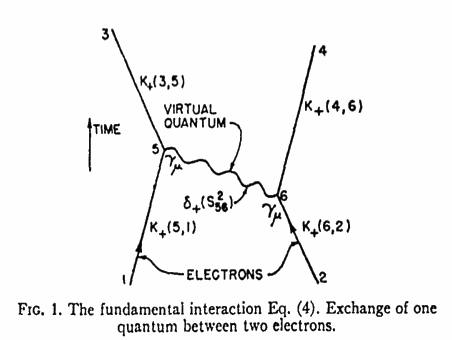
- In the 1940s, his invention of the Feynman Diagram helped bring much-needed visual clarification to the enigmatic behavior of subatomic particles.
- His work helping scientists understand the interaction of light and matter earned him a share of a Nobel Prize in 1965.
- His work has directly influenced the fields of nanotechnology, quantum computing, and particle physics.
- In 1986, his research and explanations were critical in helping to understand the cause of the space shuttle Challenger disaster.
In addition to his groundbreaking research, Feynman was brilliant, eloquent, and an exquisitely passionate thinker. In the world of science, he stands unequivocally for his ability to synthesize and explain complex scientific knowledge. His lectures are the stuff of legend — Albert Einstein attended Feynman’s first talk as a graduate student, and Bill Gates was so inspired by his pedagogy that he called Feynman, “the greatest teacher I never had.” Gates purchased the rights to his lectures and made them publicly available on a video portal nicknamed “Tuva” in honor of Feynman’s famous failed quest to reach the Russian region later in his life.
“I do think that making science cool to people when they’re young and therefore getting more people to go into it in an in-depth way, I think that’s very important right now,” Gates said, when announcingthe purchase.
Feynman’s lectures, many of which were delivered during his time at California Institute of Technology, were aimed at students who had no previous knowledge of particle physics or deep science. Taking the mystery out of complex scientific principles was Feynman’s forte. His lectures were underscored by a conviction and passion for science.
If Einstein created the ‘beautiful equation,’ then Feynman brought an unparalleled sense of beauty and romanticism previously absent in the world of scientific research. A vast majority of Feynman’s life was as vividly eccentric and illustrious as the unpredictable movements of the atomic particles that defined his life’s work. When he wasn’t in the throes of researching particle physics, he spent significant time dabbling in the arts, sketching, and even playing the bongo.
The Feynman Technique
Have you ever had a coworker who used business-speak, or had a teacher explain something with language that was difficult to understand?
You’re not alone. The Feynman technique for teaching and communication is a mental model (a breakdown of his personal thought process) to convey information using concise thoughts and simple language. This technique is derived from Feynman’s studying methods when he was a student at Princeton.
At Princeton, Feynman started to record and connect the things he did know with those he did not. In the end, Feynman had a comprehensive notebook of subjects that had been disassembled, translated, and recorded.
In James Gleick’s biography of Feynman, Genius: The Life and Science of Richard Feynman, he recalled his subject’s technique. “He opened a fresh notebook. On the title page he wrote: NOTEBOOK OF THINGS I DON’T KNOW ABOUT. For the first but not last time he reorganized his knowledge. He worked for weeks at disassembling each branch of physics, oiling the parts, and putting them back together, looking all the while for the raw edges and inconsistencies. He tried to find the essential kernels of each subject,” Gleick wrote.
You can use this model to quickly learn new concepts, shore up knowledge gaps you have (known as targeted learning), recall ideas you don’t want to forget, or to study more efficiently. Taking that concept further, you can use this technique to grapple with tough subject matter, which is one of the great barriers to learning.
Feynman’s technique is also useful for those who find writing a challenge. Feynman had an interesting relationship with writing. Instead of committing his knowledge to paper like many other scientific figures, he chose to use speech as the foundation for many of his published works. He dictated most of his books and memoirs, and his scientific papers were transcribed from his lectures.
“In order to talk to each other, we have to have words, and that’s all right. It’s a good idea to try to see the difference, and it’s a good idea to know when we are teaching the tools of science, such as words, and when we are teaching science itself,” Feynman said.
Feynman relied heavily on verbal and spoken communication, and when he turned to his cartoonish diagrams of highly scientific principles, for example, he could tap into ideas with shapes, squiggly lines, and drawings. It stripped away clunky language and allowed the power of verbal storytelling to take root.
Explaining the essentials of particle physics is extremely difficult. Before Feynman’s diagrams that earned him a Nobel Prize, there wasn’t a clear way to explain their meaning.

This is the first-ever published diagram by Feynman helped scientists track particle movements in illustrations and visual equations rather than verbose explanations. What seemed almost improbable at the time is now one of the greatest explanations of particle physics — the squiggly lines, diagrams, arrows, quarks, and cartoonish figures are now the established nomenclature and visual story that students, scientists, and readers will see when they learn about this field of science.
Essentially, the Feynman Technique is this:
1. Identify the subject
Write down everything you know about the topic. Each time you run into new sources of information, add them to the note.
2. Teach it to a child
If you can teach a concept to a child, you’re way ahead of the game.
Start with a blank note and write the topic or subject you want to teach. Then, below that topic, write everything you know about it. But, the trick is to write it plainly and simply — so that a child can understand what you’re talking about.
Doing this takes into consideration a few things:
Speaking in plain terms: Children don’t understand jargon or a lexicon of dense vocabulary. Science is full of complex terminology, which is the reason Feynman’s diagrams became so valuable. His charts illustrated things that other scientists delivered marathon lectures about.
When we speak without jargon, it frees us from hiding behind knowledge we don’t have. Big words and fluffy “business speak” cripples us from getting to the point and passing knowledge to others.
Brevity: The attention span of a child requires you to deliver concepts as if you were pitching a business idea during one short elevator ride. You better get the concept out before those doors open. Children also don’t have the ability — or mental capacity, to understand anything longer than that.
If you had difficulty putting thoughts into your note, that shows you have room to improve. This is also where the power of creativity can help you reach new heights in learning.
For Feynman, much of the pleasure in science was in this first step — unraveling his levels of understanding.
3. Identify your knowledge gaps
This is the point where the real learning happens. What are you missing? What don’t you know?
Highlighting knowledge gaps will help you when you collect and organize your notes into a cohesive story (which is the next step.) Now you can call upon your source material (lecture notes, ideas, etc.) when you run into questions about how much you do know about your topic.
If you don’t know something, hit the books. Go back to the source material and compile information that will help you fill in the cracks.
4. Organize + simplify + Tell a story
Start to tell your story. Piece together your notes and begin to spin a tale using concise explanations. Bring the most vital pieces of your knowledge about the topic together.
Practice reading your story out loud. Pretend to tell the story to a classroom of students. That way, you’ll hear where language stops being simple. Stumbles could indicate incomplete thoughts.
Use analogies and simple sentences to strengthen your understanding of the story.
This sentence, written by Feynman, encapsulates the power of this technique. What started as a question about our existence has been translated into a single sentence that can be understood by a middle school student.
“All things are made of atoms — little particles that move around in perpetual motion, attracting each other when they are a little distance apart, but repelling upon being squeezed into one another.”
Basically, Feynman says that if you know nothing about physics, the most essential scientific knowledge to understand is that everything is made up of atoms. In one simple sentence, Feynman conveys the foundational existence of our universe. It’s a master class not just for scientists, but for writers of any stripe. Get to the hypothesis in as few words as possible. Avoid clunky, verbose language.
Drawing on passions
Feynman was a believer in a multi-disciplinary approach to learning and found connections to his work in creative outlets like drawing and music. He never stopped asking questions — who, what, and why?
Einstein had his violin. Werner Heisenberg played the piano. Richard Feynman had bongos. And a passion for art. He was able to eloquently communicate, but he could also see the beauty in art, and the stories that art tells. It was as much a distraction as much as it was an unending source of inspiration he could connect to his work in particle physics.
“I wanted very much to learn to draw, for a reason that I kept to myself: I wanted to convey an emotion I have about the beauty of the world. It’s difficult to describe because it’s an emotion. … It’s a feeling of awe — of scientific awe — which I felt could be communicated through a drawing to someone who had also had that emotion. I could remind him, for a moment, of this feeling about the glories of the universe.” — Feynman discussing the intersection of art and science.
Making things stick forever
The next time you stare at an empty notebook page, think about turning that page into an opportunity.
As Feynman illustrates in his mental model, learning can be a lifelong pursuit. This technique is designed to help you study for exams and learn new subjects, but it can be easily adapted to pursue deep work. Dedicating a notebook to a place where your knowledge can grow and evolve your ideas and provide inspiration to continue following a path of ongoing learning critical to the fundamentals of deeper, meaningful work.
Today, researchers are still parsing through Thomas Edison’s notebooks and are constantly learning about how he cataloged his ideas and innovations. For Feynman, after he was done cataloging his knowledge with his technique, he had a comprehensive record of his knowledge that became a notebook he was incredibly proud of.
Armed with the Feynman technique and Evernote, anything is possible. How could you use this technique in your work? Share your story in the comments.
There’s a quote that’s often attributed to Albert Einstein which goes:
“If you can’t explain it simply, you don’t understand it well enough.”
Whether or not Einstein himself actually said this (it’s never been properly sourced, so it’s likely he didn’t), it’s still an insightful observation. It’s also one that yields a pretty powerful study tip when reversed:
If you want to understand something well, try to explain it simply.
By attempting to explain a concept in simple terms, you’ll quickly see where you have a good understanding of that concept. You’ll also be able to instantly pinpoint your problem areas, because they’ll be the areas where you either get stuck or where you end up resorting to using complex language and terminology.
This is the idea behind the Feynman Technique.
Named after the Nobel Prize-winning physicist Richard Feynman – who, in addition to being a brilliant scientist, was also called “The Great Explainer” for his ability to relay complex ideas to others in simple, intuitive ways – the Feynman Technique is a method for learning or reviewing a concept quickly by explaining it in plain, simple language.
In addition to helping you pinpoint those problem areas in the concept you’re trying to learn, the Feynman Technique gives you a quick, efficient way to shore up those areas using targeted learning. It’s a simple technique, but it’ll help you study much more efficiently once you put into action.
So how do you actually use it?
How to Use the Feynman Technique
Since the root of this technique involves explaining the concept, you could execute it in a number of ways – including literally grabbing a friend and explaining to them what you’re learning. However, you don’t always have willing friends at hand, so here’s the simpler method that just involves a sheet of paper.
- Step 1: Grab a sheet of paper and write the name of the concept at the top. You can use pretty much any concept or idea – even though the technique is named after Feynman, it’s not limited solely to math and science.
- Step 2: Explain the concept in your own words as if you were teaching it to someone else. Focus on using plain, simple language. Don’t limit your explanation to a simple definition or a broad overview; challenge yourself to work through an example or two as well to ensure you can put the concept into action.
- Step 3: Review your explanation and identify the areas where you didn’t know something or where you feel your explanation is shaky. Once you’ve pinpointed them, go back to the source material, your notes, or any examples you can find in order to shore up your understanding.
- Step 4: If there are any areas in your explanation where you’ve used lots of technical terms or complex language, challenge yourself to re-write these sections in simpler terms. Make sure your explanation could be understood by someone without the knowledge base you believe you already have.
That’s it!
3 Examples of the Feynman Technique in Action
As I mentioned earlier, simply defining a concept is only half the battle. If you want to explain is clearly, you have to apply it by working through examples.
In the spirit of eating my own dog food, I’ve included three examples of how you might use the Feynman Technique below.
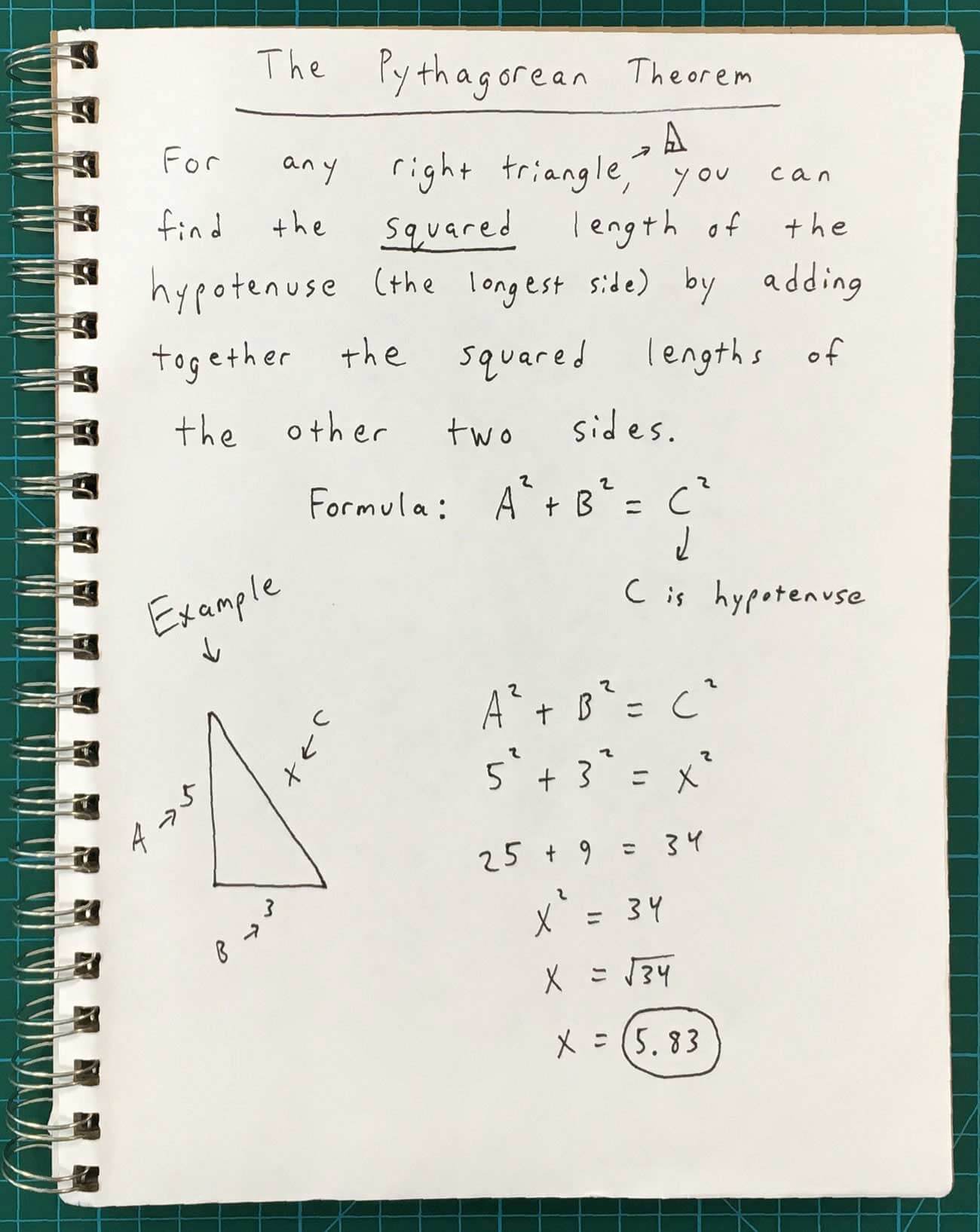
Example #1: The Pythagorean Theorem
We’ll start with a very simple example. The Pythagorean Theorem shows how you can find the length of any right triangle’s hypotenuse:
When I initially started writing this explanation, I simply wrote the sentence at the top and then added the formula.
However, note how the final page has a couple of additions:
- A small picture showing what a right triangle is
- An arrow clarifying the nature of C in the formula
This was my attempt to go back and further simplify the explanation. Even with a basic mathematical theorem like this one, there are still assumptions and terms that encompass ideas that you may not be 100% clear on. Challenge yourself to identify those things and define them.
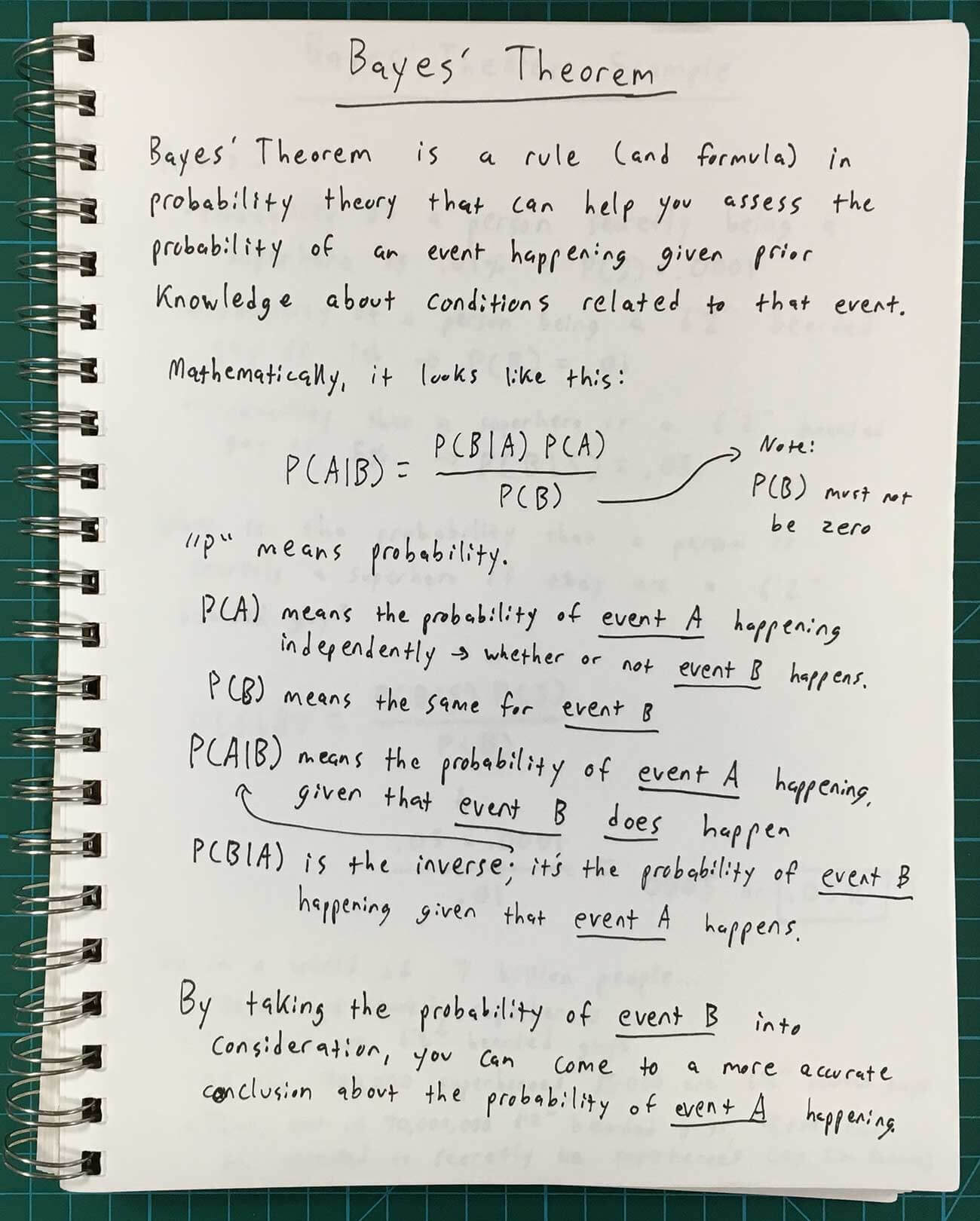
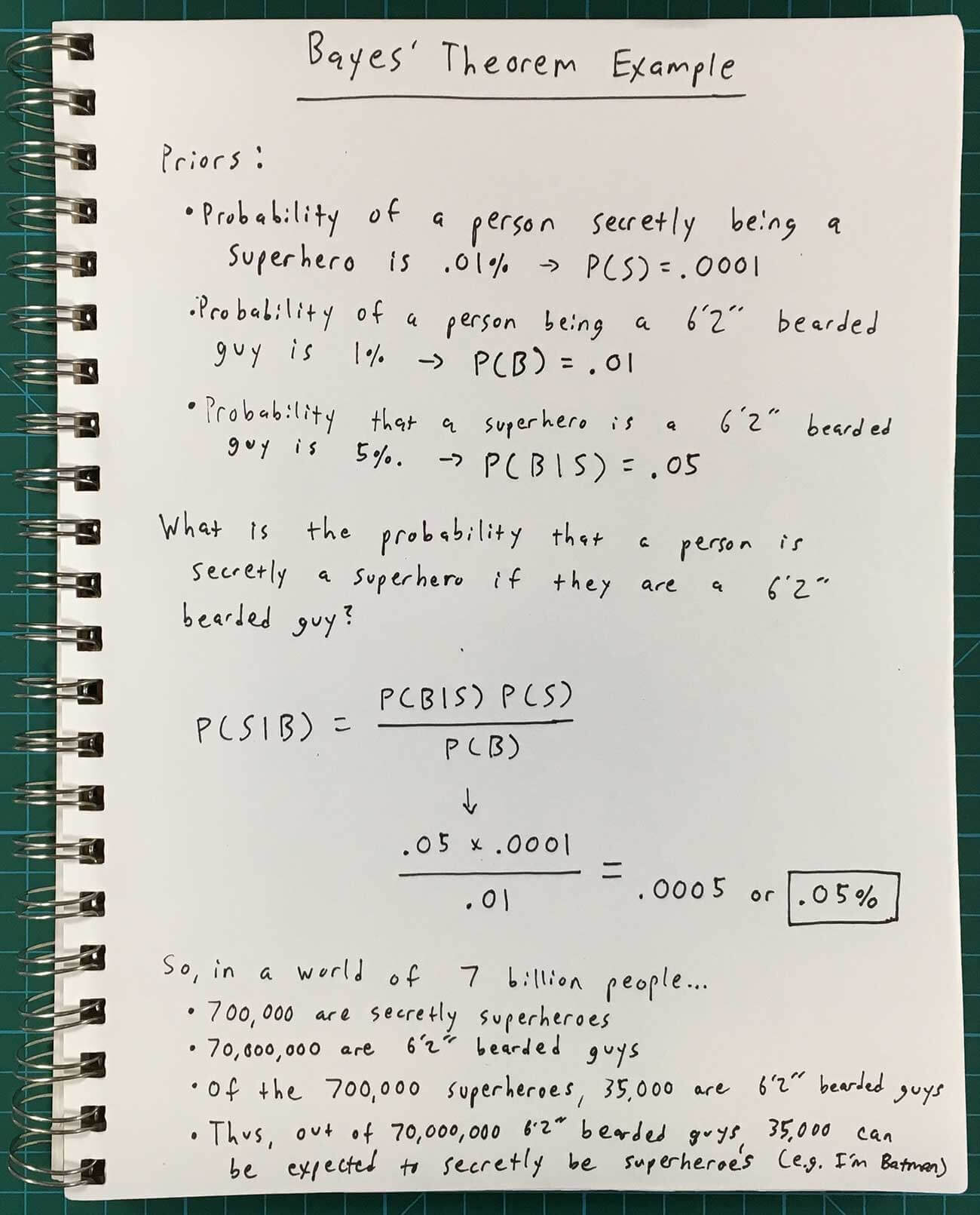
Example #2: Bayes’ Theorem
Since the Pythagorean Theorem is a pretty simple concept, I thought you might like to see an example using something more complex. Bayes’ Theorem – a concept used in probability theory and statistics – fit the bill nicely.
And here’s a page working through a specific example and using the formula:
These pages do a decent job of explaining Bayes’ Theorem at a very broad level, but I’ll be the first to admit that this is a topic that takes a good long while to truly grasp.
In fact, I had to spend three hours reading through A.I. researcher Eliezer Yudkowsky’s 15,000-word explanation of the theorem before it “clicked” in my brain, so definitely check that article out if you’re curious. You can also check out Arbital’s more recent guide, which is – by Yudkowsky’s own admission – much better and easier to follow.
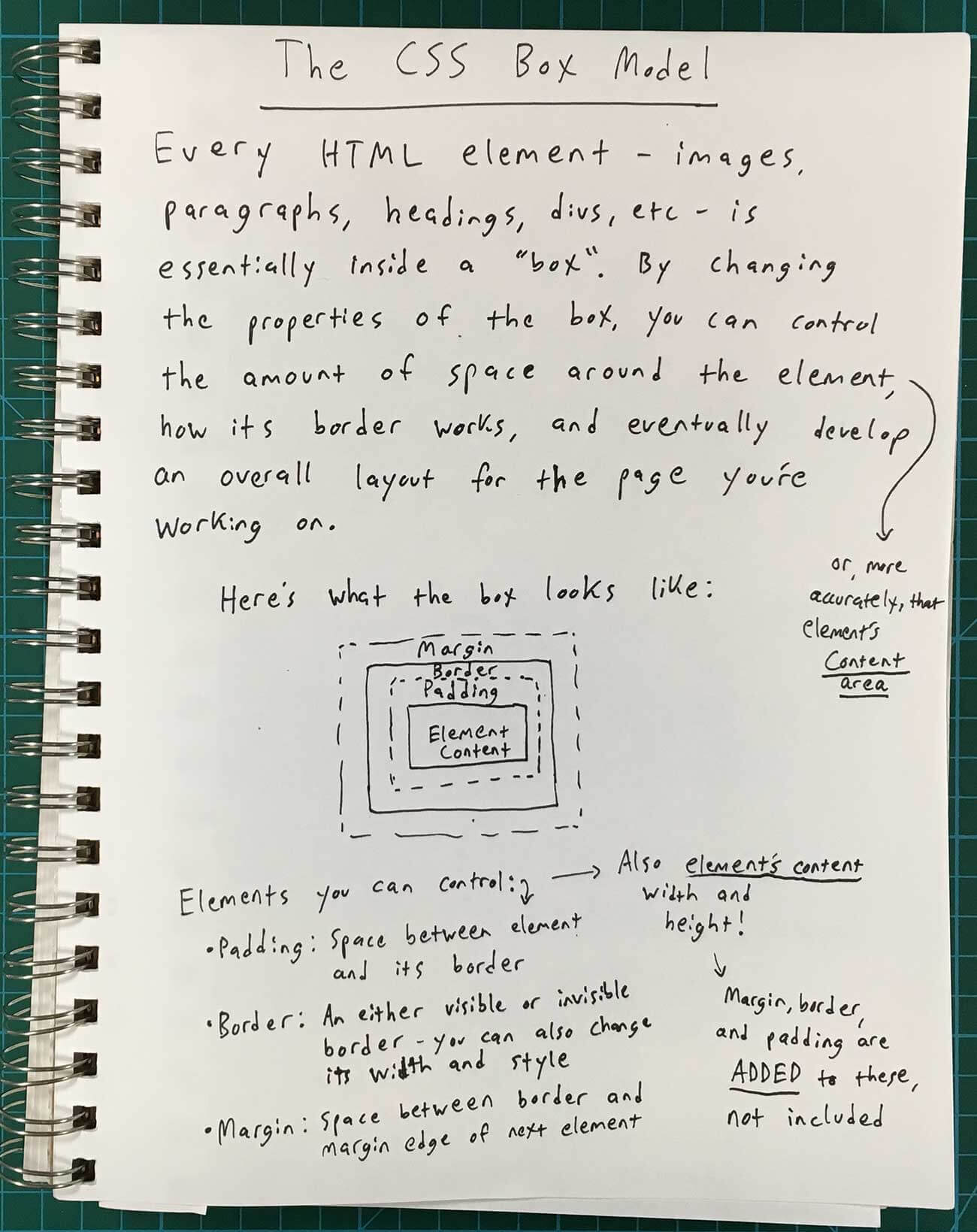
Example #3: The CSS Box Model
Here’s an example of how the Feynman Technique can be used to review a non-mathematical concept.
The CSS Box Model is a tool for representing the size of HTML elements (i.e. the code that makes up web pages just like the one you’re reading right now), as well as the spacing around them. I chose it as an example because it’s a concept that took me a long time to grasp back when I started learning how to build websites as a teenager.
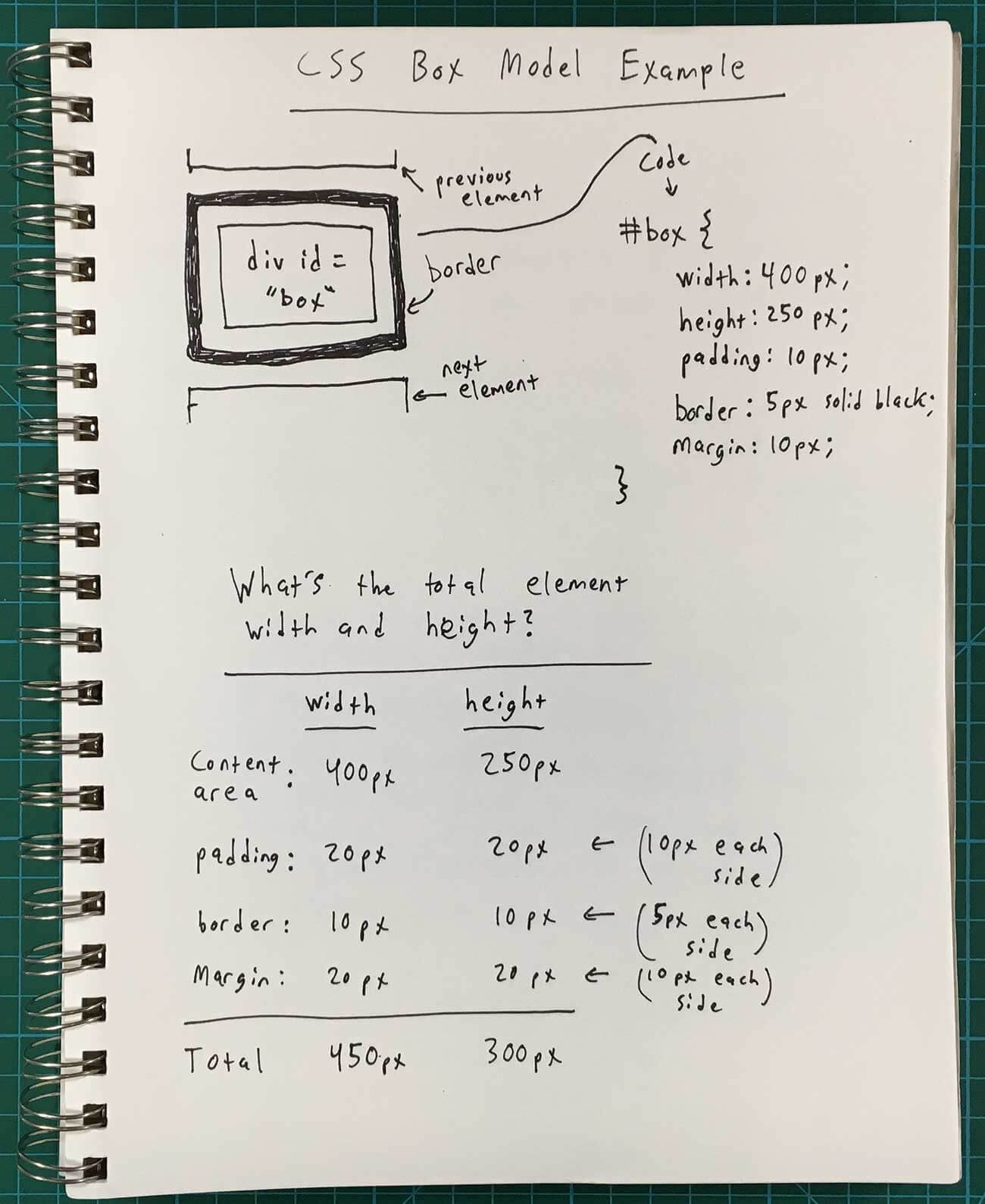
To clarify that page’s general explanation, here’s an example of an element with specific height, width, margin, padding, and border values written in CSS code:
In addition to writing the code out, I thought it would be extra helpful to show exactly how each attribute affects the overall size of the element.
To a budding web developer, it might not be immediately obvious that, say, a padding value of 10px actually increases the element’s width by 20px overall (because the 10px is applied to each side).
If you happen to be curious about the Box Model and want to learn more, check out this guide.
Think Like a Child
One final tip: While you’re working through the Feynman Technique for any given concept, it can be useful to pretend that you’re explaining that concept to a child.
Doing this will boost your own understanding for one simple reason; in addition asking things like, “Can I have another Oreo?” and “Can I go watch Dragon Ball Z now please?” a kid is probably going ask…
“Why?”
While older people often become accustomed to taking things at face value, kids are naturally curious. They’re quick to point out their confusion.
If you teach a kid how the Pythagorean Theorem works and give him the formula for using it, there’s a good chance he’ll ask you:
“Why does that formula work? How can you know it’ll always work? Prove it, sucka!”
…and then you realize that the kid was actually Mr. T in disguise all along, and now your life depends on being able to explain a geometry concept. How did you even get here?
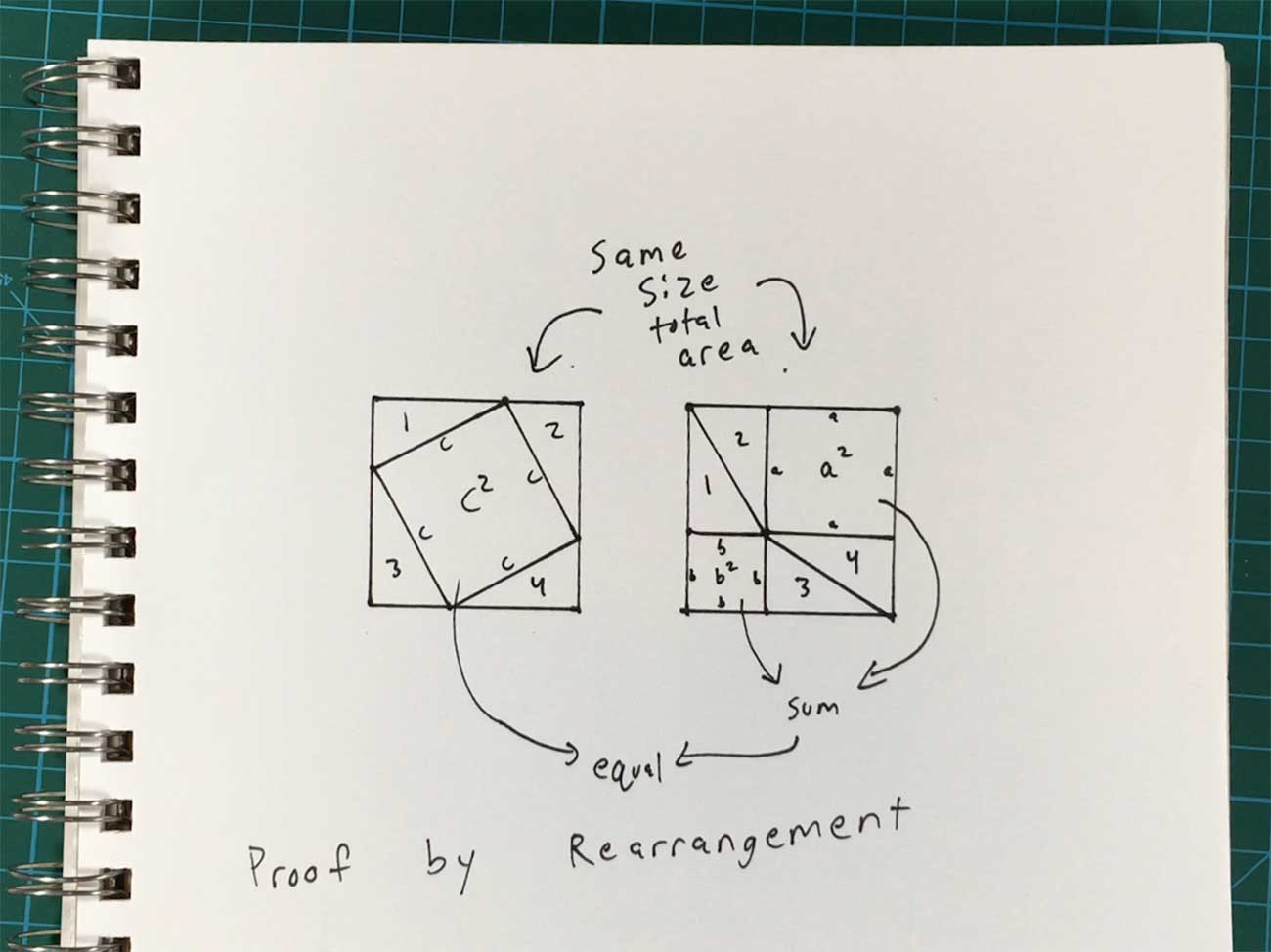
Seriously, though, this is a great mindset to adopt. Maybe you do know how the Pythagorean Theorem works, and maybe you can easily draw out the proof by rearrangement:
When it comes to other concepts, though, it’s likely that you’re relying on assumptions, heuristics, and other black boxes when it comes to certain details. So adopt a child-like mindset and challenge yourself to clearly explain the whole concept.
Once you’ve done that and worked through all the steps, you can further refine your knowledge of whatever you’re studying with other techniques, including:
Hope this helps!
If you’re unable to see the video above, you can view it on YouTube.
Looking for More Study Tips?
If you enjoyed this article, you’ll also enjoy my free100+ page book called 10 Steps to Earning Awesome Grades (While Studying Less).
The book covers topics like:
- Defeating procrastination
- Getting more out of your classes
- Taking great notes
- Reading your textbooks more efficiently
…and several more. It also has a lot of recommendations for tools and other resources that can make your studying easier.
If you’d like a free copy of the book, let me know where I should send it:
https://collegeinfogeek.com/feynman-technique/
Suscribirse a:
Entradas (Atom)
zen consultora
Entrada destacada
Platzy y el payaso Freddy Vega, PLATZI APESTA, PLATZI NO SIRVE, PLATZI ES UNA ESTAFA, Platzy and the Clown Freddy Vega, PLATZI SUCKS, PLATZI IS A SCAM
Platzy and the clowns Freddy Vega and Cvander – Part 1, PLATZI IS A SCAM Hello friends, this post will keep growing as I continue writing...